
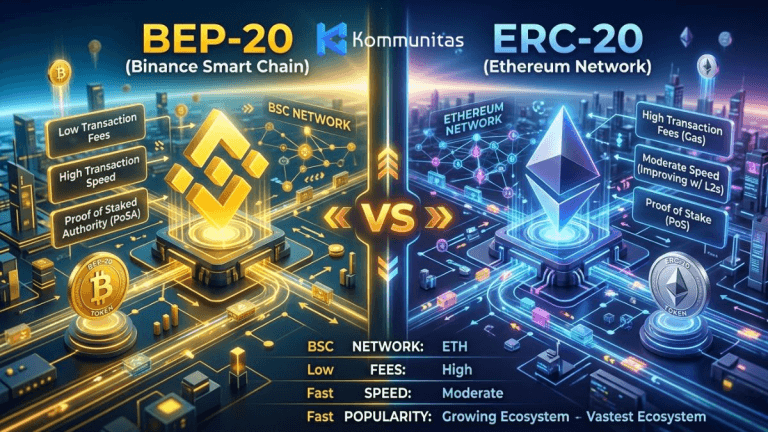
In the fast-moving world of decentralized finance, understanding the "language" your assets speak is just as important as the assets themselves. If you’ve ever tried to withdraw USDT from an exchange or participate in a launchpad, you’ve likely faced the classic dilemma: Should I use BEP-20 or ERC-20?
Choosing the wrong network is more than a minor inconvenience; it’s a leading cause of lost funds in the crypto space. As a tierless launchpad committed to investor protection, Kommunitas prioritizes clarity. Whether you are a seasoned whale or just starting your journey, this guide will break down these two dominant standards so you can transact with confidence.
What Are Token Standards, Anyway?
Think of a blockchain like a country and a token standard like its official currency rules.
- ERC-20 is the blueprint for tokens on the Ethereum network.
- BEP-20 is the blueprint for tokens on the BNB Smart Chain (BSC).
These standards ensure that tokens are compatible with wallets, decentralized exchanges (DEXs), and platforms like Kommunitas. Without them, every developer would have to invent their own way to "send" or "receive" money, making the ecosystem a chaotic mess.
ERC-20: The Decentralized Gold Standard
Launched in 2015, ERC-20 is the veteran of the industry. It powers the vast majority of the world’s most famous DeFi protocols and stablecoins.
Why Investors Choose ERC-20:
- Unmatched Security: Ethereum’s massive network of validators makes it one of the most secure and decentralized blockchains in existence.
- Institutional Trust: Most major institutional projects and high-value assets prefer Ethereum due to its longevity and robust infrastructure.
- Global Ecosystem: Almost every wallet and exchange in existence supports ERC-20 by default.
The Trade-off:
The main hurdle for ERC-20 users is Gas Fees. During times of high network congestion, a single transaction can cost anywhere from $5 to over $50. This makes it less ideal for micro-transactions or frequent trading for retail investors.
BEP-20: Efficiency and Accessibility
BEP-20 was designed to address Ethereum’s scalability issues. It is essentially an extension of the ERC-20 standard but optimized for the BNB Smart Chain.
Why Investors Choose BEP-20:
- Lightning Speed: While Ethereum takes about 12–15 seconds to confirm a block, BSC does it in roughly 3 seconds.
- Ultra-Low Fees: Transactions on BSC typically cost between $0.01 and $0.30. For active traders, this is a game-changer.
- Launchpad Friendly: Because participation in Initial KOMmunity Offerings (IKOs) often involves multiple small transactions (staking, claiming, voting), the low fees of BEP-20 make it the preferred choice for the Kommunitas community.
The Trade-off:
BEP-20 is more centralized than ERC-20. It relies on a smaller number of validators, which is why it can offer such high speeds and low costs.
Technical Comparison (2026 Data)
Feature | ERC-20 (Ethereum) | BEP-20 (BNB Smart Chain) |
Network | Ethereum Mainnet | BNB Smart Chain (BSC) |
Consensus | Proof of Stake (PoS) | Proof of Staked Authority (PoSA) |
Avg. Fee (2026) | $1.50 - $12.00 | $0.01 - $0.15 |
Block Time | ~12 Seconds | ~3 Seconds |
Primary Use | High-value assets, Security | Retail trading, Gaming, IKOs |
Native Gas Token | ETH | BNB |
A Practical Workflow: How to Move Between Networks
If you have ERC-20 tokens but want to participate in an IKO on Kommunitas using the BSC network, you’ll need to "bridge" your assets.
- Select a Bridge: Use a trusted cross-chain bridge or a centralized exchange like Bitget or Binance.
- Check Gas Funds: Ensure you have ETH for gas on the Ethereum side and BNB for gas on the BSC side.
- Verify the Address: Most wallets (like MetaMask) use the same address for both networks, but you must ensure your wallet is toggled to the correct network.
- Execute the Swap: Send your ERC-20 tokens to the bridge; they will be locked, and an equivalent amount of BEP-20 tokens will be minted for you.
Pro Tip: Never send BEP-20 tokens directly to an exchange address that only supports ERC-20. Always check the "Network" dropdown menu before hitting send!
Why Kommunitas Champions the Tierless Model
At Kommunitas, we believe everyone should have a seat at the table. While ERC-20 remains a pillar of the industry, the efficiency of the BNB Smart Chain allows us to maintain a tierless system. By keeping transaction costs low, we ensure that even the smallest investors can participate in high-growth Web3 projects without their profits being swallowed by gas fees.
Whether you are holding assets for the long term on Ethereum or hunting for the next 100x gem on BSC, understanding these standards is your first step toward mastery.
Frequently Asked Questions
1. Can I send ERC-20 tokens to a BEP-20 address?
Technically, the addresses look identical in wallets like MetaMask. However, if you send tokens across networks without using a bridge or a supporting exchange, the tokens will be stuck on the wrong blockchain.
2. Why do I need BNB to send my BEP-20 tokens?
Every blockchain has a "fuel." For Ethereum, it's ETH. For BNB Smart Chain, it's BNB. Even if you are sending a stablecoin like USDT, you must have a small amount of the native token to pay the network validators.
3. Which standard is "safer"?
Ethereum (ERC-20) is generally considered more secure due to its high level of decentralization. However, BSC (BEP-20) is highly secure for everyday trading and is backed by a robust ecosystem.
4. How does the "Universal IKO" relate to these standards?
OurUniversal IKO model utilizes on-chain identity scores, allowing for cross-chain participation. While we support various standards, the efficiency of BEP-20 remains a cornerstone of our user experience.
Conclusion: Take Your Next Step
The "best" standard depends entirely on your goals. Use ERC-20 for maximum security and institutional-grade decentralization. Use BEP-20 when you need speed, low fees, and active participation in the DeFi ecosystem.
Ready to put your knowledge into practice?Check out our latest IKOs and see how our tierless system empowers investors across all networks.
References:
- ERC-20 Token Standard - Ethereum.org
- What is BEP-20 and How Does it Differ from ERC-20? - Bitget Academy
- ERC20 vs BEP20: Understanding the Key Differences - Godex.io