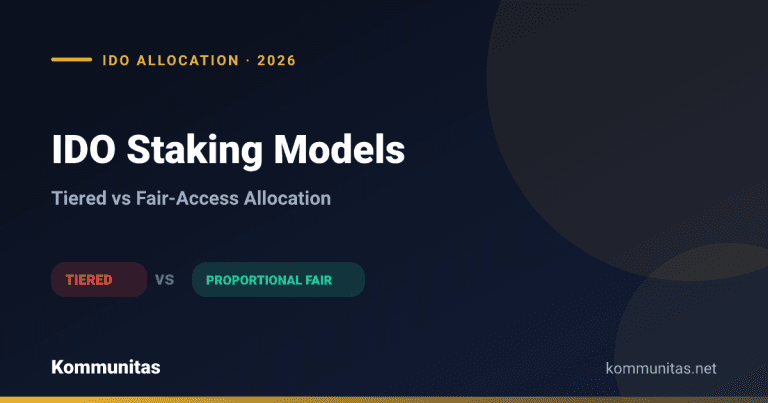
tl;dr: Most launchpads use tiered staking — the more tokens you lock, the higher your tier, and the bigger your guaranteed allocation. It rewards whales and locks out small retail investors. Lottery models fix the whale problem but replace it with pure luck. Kommunitas uses a third model: stake any amount of $KOM, get Human Passport-verified, and receive a proportional guaranteed allocation in the universal sale — no tiers, no lottery, no minimum that locks you out entirely.
If you want into an IDO, staking is usually the gatekeeper. But "staking for allocation" isn't one system — it's several competing models, and which one a launchpad uses determines whether a small investor actually has a fair shot or gets crowded out before the sale even opens. Here's how each model really works, and what to look for.
Model 1: Tiered Staking
Tiered staking sorts participants into tiers (Bronze, Silver, Gold, Diamond) based on how many tokens they stake. Higher tiers get bigger guaranteed allocations, earlier access, and sometimes exclusive rounds. This is the dominant model on platforms like DAO Maker, Polkastarter, and Seedify.
The Problem With Tiers
Tiers concentrate allocation with whales. If the top tier requires $50,000+ staked, retail investors with a few hundred dollars are functionally locked out of guaranteed rounds — they're pushed into leftover FCFS scraps, if any exist at all. The "guaranteed" allocation only feels guaranteed if you can afford the tier that unlocks it.
Model 2: Lottery-Based Staking
Lottery models give every staker a chance — often weighted by stake size — to win an allocation slot. It solves the whale-domination problem on paper: theoretically, a small staker has a shot at the same allocation as a large one.
The Problem With Lottery
In practice, lottery replaces one form of unfairness with another: randomness. You can stake for months and still get nothing, with no way to plan around it. It also does nothing to guarantee investors get any allocation for their time and capital locked — you're gambling on top of investing.
Model 3: FCFS (First-Come-First-Served)
Some platforms drop tiers and lotteries entirely and let stakers race to claim allocation the moment a round opens. It sounds fair — no tiers, no luck — but it rewards whoever has the fastest bot, the best RPC connection, and the quickest reflexes. Ordinary retail investors rarely win a pure FCFS race against automated scripts.
Model 4: Proportional Guaranteed Allocation (Kommunitas)
Kommunitas takes a different approach: stake any amount of $KOM — there's no minimum tier that locks you out — and your guaranteed allocation scales proportionally with your stake. A small staker gets a small guaranteed allocation; a large staker gets a proportionally larger one. Nobody is excluded by an arbitrary tier threshold, and nobody has to win a lottery or out-race a bot.
This works because allocation isn't decided by staking alone — it's paired with Human Passport verification, which confirms each participant is a real, unique person. That Sybil resistance is what makes proportional allocation safe to offer without whales spinning up hundreds of wallets to game the system. The result is what Kommunitas calls a universal sale: staking-based, proportional, and open to any verified human regardless of how much capital they bring.
Tiered vs Lottery vs FCFS vs Proportional: Quick Comparison
- Tiered staking. Predictable, but favors whales; small stakers often get nothing.
- Lottery. Chance-based; no guarantee even after staking and waiting.
- FCFS. Speed-based; favors bots over ordinary investors.
- Proportional (Kommunitas). Guaranteed and scaled fairly — no tier lockout, no luck, no bot race.
For a deeper look at why removing tiers specifically matters, see why the tierless model is the future of fair investing, and for how the FCFS-vs-guaranteed trade-off plays out in practice, check FCFS vs guaranteed allocation.
How to Evaluate a Launchpad's Staking Model Before You Commit
Before locking any tokens, ask three questions: Does a minimum tier exist that could shut me out entirely? Is my allocation guaranteed, or dependent on luck or speed? And how does the platform stop one person from gaming the system with multiple wallets? A platform that answers all three well — no minimum lockout, guaranteed proportional allocation, and Sybil resistance via something like proof of humanity — is structurally fairer than one relying on tiers, lotteries, or bot races alone.
FAQ
Do I need a minimum amount of $KOM to get any allocation?
No. Kommunitas's proportional model means any amount staked contributes to a guaranteed allocation scaled to your stake — there's no tier threshold that locks you out of the guaranteed round entirely.
Is proportional allocation the same as FCFS?
No. FCFS allocates based on transaction speed after a round opens, which favors bots and fast connections. Proportional guaranteed allocation is calculated from your staked amount before the round even opens, so speed doesn't determine your outcome.
Why is lottery-based staking considered less fair than proportional models?
Because lottery introduces pure chance on top of your investment — you can stake responsibly and still receive nothing, with no way to plan or guarantee an outcome. Proportional models remove that randomness by guaranteeing an allocation scaled to your stake.
How does Human Passport connect to the staking model?
Human Passport verifies that each staker is a unique real person, which prevents Sybil attacks (one person creating many wallets to farm allocation). That verification is what allows Kommunitas to offer proportional guaranteed allocation safely, without whales gaming the system through multiple fake accounts.
Conclusion
Not all "staking for IDO allocation" systems are created equal. Tiered staking favors whales, lottery introduces gambling, and FCFS favors bots. A proportional, Sybil-resistant model — where every verified human gets a guaranteed allocation scaled fairly to their stake — is the closest thing to a level playing field currently available on crypto launchpads. Before staking anywhere, check which model you're actually staking into.
Related Reading
- Tiered vs Lottery IDO: Why Tierless Is the Future of Fair Investing
- FCFS vs Guaranteed Allocation: Which IDO Model Actually Puts Money in Your Wallet?
Disclaimer: This article is for educational and informational purposes only and is not financial or investment advice. Allocation models, staking requirements, and terms vary by platform and can change. Always do your own research (DYOR) before staking or participating in any token sale.
References: