
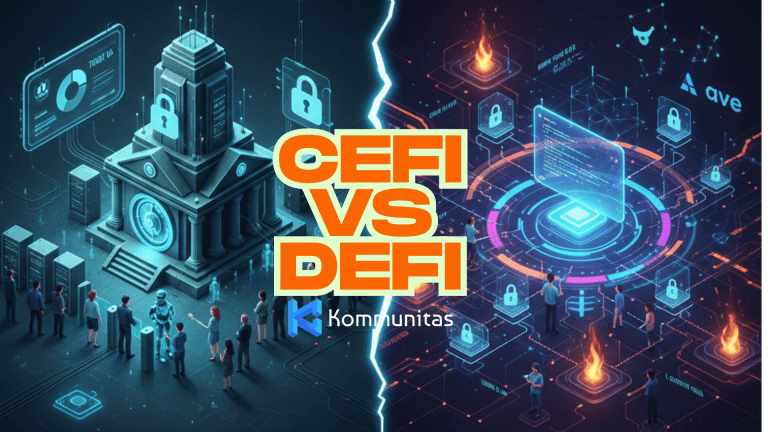
The world of crypto finance is broadly divided into two competing, yet sometimes complementary, ideologies: Centralized Finance (CeFi) and Decentralized Finance (DeFi). Understanding the core difference between CeFi and DeFi is not just an academic exercise—it is essential for navigating the Web3 ecosystem and managing digital assets securely and profitably.
As an expert crypto analyst with deep experience in both financial market structures and blockchain technology, I’ll break down these two paradigms, focusing on the structures, benefits, and risks that define them in the current 2026 landscape.
What Is CeFi (Centralized Finance)?
Centralized Finance (CeFi) refers to financial services that operate under the control of a single, central intermediary company. These companies act as trusted third parties, much like traditional banks or brokerages, but they deal exclusively or primarily with cryptocurrency assets.
CeFi platforms bridge the gap between traditional finance (TradFi) and the crypto world, offering familiar user experiences, customer support, and regulatory compliance.
How CeFi Works
CeFi platforms are characterized by their custodial service model. When a user deposits funds onto a platform like Binance or Coinbase, they transfer control of their private keys to the company. The company then holds and manages those assets on the user's behalf.
Order Book Trading: CeFi exchanges, or CEXs, use a classic centralized order book model to match buyers and sellers.
Asset Management: The platform aggregates user funds to offer services like lending, borrowing, staking, and high-yield savings accounts. They manage the internal risk and determine interest rates.
Fiat On/Off-Ramps: Crucially, CeFi platforms facilitate the easy conversion between fiat currencies (USD, EUR, etc.) and crypto, a process that is typically challenging for pure DeFi.
Benefits of CeFi
User Experience (UX): CeFi platforms are designed with intuitive interfaces, making them ideal for beginners They offer familiar account management, password resets, and dedicated customer support
Fiat Integration: Seamless, regulated fiat-to-crypto conversion is a major advantage for global accessibility
Liquidity: Centralized exchanges often command the deepest trading liquidity for major assets, ensuring large orders can be executed with minimal price impact.
Regulatory Compliance: CeFi companies typically adhere to Know Your Customer (KYC) and Anti-Money Laundering (AML) regulations, providing legal protection and recourse options to users in many jurisdictions
Risks & Limitations of CeFi
Custody Risk (Counterparty Risk): The core risk is that you must trust the centralized entity with your funds. As the collapses of major CeFi lenders in 2022 demonstrated, mismanagement, lack of transparency, or insolvency can lead to total loss of user funds.
Example: If you don't hold the private keys, you don't control the crypto. The platform has the ability to freeze withdrawals or assets.
Censorship: Centralized platforms are subject to government and regulatory mandates and can be compelled to block or freeze specific accounts or transactions.
Lack of Transparency: Internal operations, solvency, and collateralization ratios are often opaque, making it difficult for users to independently verify the platform's financial health.
What Is DeFi (Decentralized Finance)?
Decentralized Finance (DeFi) is an open, permissionless, and transparent financial ecosystem built on blockchain networks, primarily Ethereum and its Layer-2 solutions. DeFi seeks to replicate and innovate upon traditional financial services without the need for any central authority, relying instead on code—specifically smart contracts—to govern all transactions.
How DeFi Works
DeFi platforms operate as non-custodial protocols Users maintain full control over their assets via their private keys, typically using a Web3 wallet like MetaMask. Users interact directly with the smart contract code.
Smart Contracts: All financial logic (interest rate calculation, collateral liquidation, token swaps) is automated and executed by tamper-proof code deployed on a public blockchain.
Liquidity Pools: Instead of order books, Decentralized Exchanges (DEXs) like Uniswap and PancakeSwap use Automated Market Makers (AMMs). Users provide assets to liquidity pools, and traders swap against these pools, with fees going back to the liquidity providers.
Governance: Many protocols are governed by a Decentralized Autonomous Organization (DAO), where token holders vote on key decisions, enhancing community ownership and censorship resistance.
Benefits of DeFi
Financial Autonomy: Self-custody is the foundation. Since you hold your private keys, no third party can seize or freeze your assets (barring smart contract bugs or a loss of your keys).
Transparency: All transactions, collateral amounts, and protocol code are publicly auditable on the blockchain, providing a high degree of verifiable truth.
Permissionless Access: Anyone, anywhere in the world, with an internet connection and a crypto wallet can access DeFi services without needing to complete KYC/AML.
Composability & Innovation: Protocols are open-source and can be easily "plugged into" one another, fostering rapid innovation in areas like yield strategies, derivatives, and synthetic assets. Aave's lending markets, for example, can be leveraged by yield aggregators like Yearn Finance.
Risks & Limitations of DeFi
Smart Contract Risk: The reliance on code means a vulnerability or bug in the smart contract can be exploited, leading to permanent loss of funds, a risk that has plagued many protocols.
High Complexity: DeFi platforms often have steeper learning curves, requiring users to understand concepts like gas fees, non-custodial wallets, and different Layer-1/Layer-2 networks.
Impermanent Loss: A specific risk for liquidity providers in AMMs, where the value of their deposited tokens changes relative to simply holding them (a concept unique to decentralized exchanges).
No Customer Support: If you lose your private key or make an incorrect transaction, there is generally no one to call for help; the responsibility for asset security is entirely on the user.
CeFi vs DeFi: Side-by-Side Comparison Table
The fundamental difference between CeFi and DeFi is best illustrated by comparing their core features, especially concerning the custodial model and regulatory approach.
Which One Is Better for Users?
There is no definitive "better" option; the choice between CeFi and DeFi depends entirely on a user's priorities, risk tolerance, and technical proficiency.
Choose CeFi if you prioritize:
Simplicity and Security: You want an easy-to-use interface, customer service, and the ability to recover a lost password. You prefer trusting a regulated entity over mastering self-custody.
Fiat/TradFi Integration: You frequently move money between traditional banking and crypto.
Choose DeFi if you prioritize:
Financial Autonomy and Censorship Resistance: You absolutely need to retain full control of your private keys ("Not your keys, not your crypto").
Transparency and Innovation: You want publicly auditable financial activities and access to cutting-edge financial primitives like flash loans and complex yield strategies.
The most experienced crypto users often adopt a hybrid approach, using CeFi platforms like Coinbase for secure fiat on-ramps and then transferring assets to self-custodied wallets to interact with DeFi protocols like Aave for lending or Curve for stablecoin swaps.
Use Cases in Real World
CeFi Use Cases
Bridging Fiat and Crypto: Serving as the primary gateway for mass adoption, enabling new users to securely purchase crypto with fiat currency.
Institutional Custody: Providing highly regulated, secure digital asset custody solutions for institutional investors and corporations.
Cross-Chain Interoperability: Using centralized control to facilitate swaps and transfers between otherwise incompatible blockchains (e.g., Bitcoin and Ethereum networks).
DeFi Use Cases
Decentralized Lending & Borrowing: Providing overcollateralized loans where interest rates are determined algorithmically by supply and demand, entirely without intermediaries (Aave, Compound).
Decentralized Trading: Facilitating trustless, peer-to-peer trading through decentralized exchanges (DEXs) like Uniswap, which eliminate the need for a central order book.
Tokenization of Real-World Assets (RWAs): Using blockchain to represent ownership of traditional assets (real estate, fine art, private equity) on-chain, creating new liquidity opportunities.
Decentralized Insurance: Offering protection against smart contract risk and exchange hacks through peer-to-peer insurance markets (e.g., Nexus Mutual).
Future Outlook: The Convergence of Finance
The future outlook for the difference between CeFi and DeFi suggests a continued convergence, a trend that is accelerating in 2026.
Regulation: Regulators globally are working to create clearer frameworks for CeFi and, increasingly, for DeFi protocols (especially those with central points of failure or high governance risk). This will push CeFi to become more transparent and DeFi to become more secure and compliant.
Hybrid Models: We are seeing the rise of hybrid custodial models (like MPC wallets or semi-decentralized exchanges) that aim to offer the user-friendliness of CeFi with the self-custody principles of DeFi. Institutional DeFi (permissioned pools on protocols like Aave) is another example of this blending, bringing traditional capital to the decentralized ecosystem.
Scalability: Layer-2 scaling solutions (Arbitrum, Optimism) are drastically reducing the high transaction costs and long confirmation times that once plagued DeFi, making it more competitive with the low-fee structure of CeFi.
Ultimately, CeFi and DeFi are not mutually exclusive. They represent different risk and control trade-offs, and they are increasingly finding ways to complement each other to build a more robust, globally accessible financial system.
Conclusion
The debate over CeFi vs DeFi boils down to trust—trusting a centralized business entity versus trusting verifiable, open-source code. While CeFi offers convenience, regulatory comfort, and customer support, it demands sacrificing control over your assets. DeFi offers unparalleled autonomy, transparency, and innovation, but it requires users to take on the full responsibility of self-custody and smart contract risk.
The most savvy investors in 2026 understand the strengths and weaknesses of both models and deploy their capital strategically across the two ecosystems to optimize for different goals: using CeFi for liquidity and onboarding, and DeFi for high-yield, self-custodied financial strategies.
FAQ Section
1. What is the main difference between CeFi and DeFi?
The main difference between CeFi and DeFi is the reliance on intermediaries and the custodial model. CeFi uses centralized companies (e.g., Coinbase) to hold and manage user funds (custodial), requiring trust in that entity. DeFi uses automated smart contracts on a blockchain, allowing users to keep control of their keys (non-custodial) in a trustless environment.
2. Is CeFi more secure than DeFi?
CeFi platforms are generally considered more secure from a user-error standpoint, as they offer customer support and often operate under financial regulation with security measures like insurance. However, they carry counterparty risk (the company could fail). DeFi is secure if the underlying code is robust, but it carries smart contract risk (vulnerabilities in the code) and puts 100% of the responsibility for security on the user.
3. What is a "custodial service" in the context of CeFi?
A custodial service means that a third party, like a CeFi exchange, holds the private cryptographic keys for your digital assets. While you see a balance in your account, the platform technically controls the ability to move the funds.
4. How do DeFi protocols generate liquidity for trading?
DeFi trading, primarily on Decentralized Exchanges (DEXs), generates liquidity not through traditional order books but through liquidity pools. Users lock two different assets into a smart contract, becoming liquidity providers (LPs). Traders swap tokens using the assets in the pool, and LPs earn a portion of the trading fees.
5. What are the key risk factors in DeFi?
The key risks in DeFi are smart contract risk (bugs or exploits in the code), governance risk (malicious proposals voted in by token holders), and impermanent loss (for liquidity providers).
6. Can I convert fiat currency to crypto using DeFi?
No, a pure DeFi protocol cannot directly handle fiat currency. You must use a CeFi platform like Coinbase or a regulated fiat on-ramp service that bridges the traditional banking system with the blockchain to get crypto into your self-custody wallet before using DeFi.
Footnote References
I. Core Conceptual & Academic Frameworks
Qin, K., Zhou, L., & Gervais, A. (2021). CeFi vs. DeFi - Comparing Centralized to Decentralized Finance. arXiv preprint arXiv:2106.02701. (Authoritative academic work providing a structured methodology for differentiation based on design and architecture.)
Schuler, K., Cloots, A. S., & Schär, F. (2024). On DeFi and On-Chain CeFi: How (Not) to Regulate Decentralized Finance. Journal of Financial Regulation, 10(2), 213–244. (Interdisciplinary article defining genuine DeFi vs. on-chain CeFi and discussing custodial properties for regulators.)
Bank for International Settlements (BIS). (2024). The Crypto Ecosystem: Challenges and Regulatory Responses. BIS Quarterly Review. (General authority on market structure, financial stability, and connectivity risks between crypto and core financial systems.)
IOSCO. (2023). Final Report with Policy Recommendations for Decentralized Finance (DeFi). International Organization of Securities Commissions. (Global regulatory body defining policy recommendations and addressing market integrity and investor protection concerns in DeFi.)
II. Market Structure, Custody, and Risk Analysis
Komodo Platform. (2026). Decentralized vs Centralized Exchanges: A Complete Guide. Komodo Platform Academy. (Industry comparison highlighting the custodial nature of CEXs versus the non-custodial nature of DEXs, and associated security trade-offs.)
Bank of Canada. (2024). Market structure of cryptoasset exchanges: Introduction, challenges and emerging trends. Staff Analytical Note. (Report focusing on the centralized exchange model, their role as fiat gateways, and the inherent risks of substituted private ledgers, citing the FTX collapse.)
Hacken. (2024). The Hacken 2024 Web3 Security Report. (Industry report providing data on losses from DeFi smart contract exploits versus CeFi hacks/insolvencies, detailing risk vectors like access control exploits.)
Eurofi. (2023). DeFi opportunities and challenges. Eurofi Forum Summary. (Discusses risks related to governance, oracles, and the difficulty regulators face due to the lack of a legal person in autonomous DeFi protocols.)
III. Platform Examples and Use Cases
Coinbase Official Website. (Accessed 2025). Custodial Services and Regulatory Compliance Documentation. (Primary source for CeFi user experience, fiat integration, and regulatory adherence.)
Uniswap Labs. (Accessed 2025). Uniswap Documentation: Automated Market Makers (AMM) and Liquidity Pools. (Primary source for explaining the non-custodial and algorithmic mechanism of decentralized exchange liquidity.)
Aave Protocol. (Accessed 2025). Aave Protocol V3 Technical Documentation. (Primary source for DeFi lending/borrowing mechanisms, detailing smart contract-governed collateral and interest rate algorithms.)
Financial Conduct Authority (FCA). (Accessed 2025). Digital Assets and Crypto Regulation Updates. (Official source for UK regulatory stance on CeFi and stablecoins, demonstrating compliance requirements for centralized entities.)
Related reading: Memecoin.