If you've tried to join a Seedify launch lately and noticed the price moving while you were still reading the rules, you've already met the bonding curve. It's one of the biggest shifts in how crypto launchpads sell tokens in 2026 — and it quietly changes who gets a good deal and who pays a premium. This guide breaks down exactly how Seedify's bonding curve works, what it does well, where it bites smaller buyers, and how it stacks up against a flat, guaranteed-allocation model. No hype, no jargon walls — just the mechanics and the trade-offs so you can decide if it's right for your size of wallet.
What Is a Bonding Curve, in Plain English?
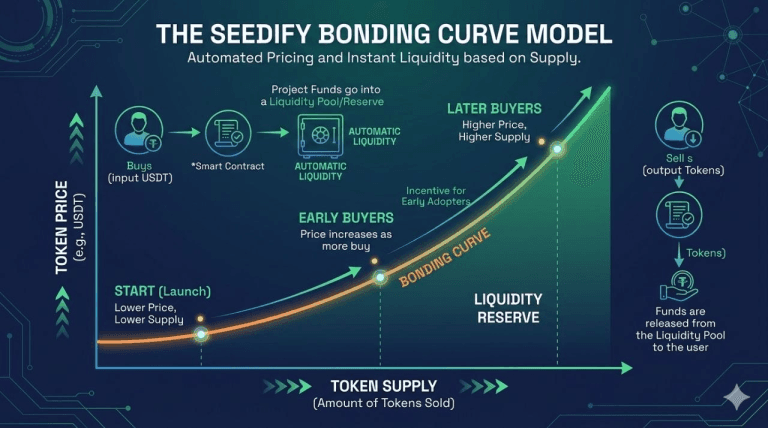
A bonding curve is a pricing formula. Instead of fixing a single price for everyone (the classic IDO model), the token price is tied to how much has already been bought. Buy early, when little supply has been sold, and you pay less. Buy later, after demand has pushed along the curve, and you pay more. The math is transparent and on-chain — but the outcome is simple: price rises as the sale fills up.
Seedify adopted this model — internally branded around "vibe" sales — as one of several launch mechanics it now offers. It sits alongside permissioned IDOs, community-voted launches, curated launches, and milestone-based IMO funding. The bonding curve is the one that behaves most like the pump.fun-style launches retail traders have seen on memecoins, now applied to a serious, KYC-gated launchpad.
How Seedify's Bonding Curve Actually Works
Here's the flow, step by step, without the whitepaper fog:
- Staking tier sets your priority. Your SFUND staking tier determines how early you can enter and how large your access window is. Higher tiers get in first — which on a rising curve means they get the lowest prices.
- The curve prices each purchase. Every buy moves the price up the curve a little. The first buyers anchor near the floor; the last buyers pay closer to the ceiling.
- Speed becomes an advantage. Because price climbs with cumulative volume, being fast (and being in a high tier) is rewarded. Hesitate, and the same allocation costs more.
- Instant liquidity and price discovery. The curve doubles as a price-discovery and liquidity mechanism — the market sets the clearing price live, rather than a team guessing a fixed number.
It's elegant engineering. But notice what it optimizes for: early entry and speed. That's great if you're a high-tier staker watching the launch at 9:00 a.m. sharp. It's less great if you're a small retail buyer who found the project an hour after it opened.
The Honest Case FOR Bonding Curves
Let's be fair — this model has real strengths, and pretending otherwise would be dishonest SEO, not analysis:
- Early supporters are rewarded. Conviction gets a discount. People who believe early and act early pay the lowest prices — arguably how it should be.
- Transparent, on-chain pricing. There's no opaque insider round. The formula is public, and anyone can verify the price at any fill level.
- Built-in liquidity. The curve provides immediate two-sided liquidity, reducing the "no buyers after TGE" problem that kills many launches.
- Market-driven discovery. Instead of a team mispricing the raise, the market finds the level in real time.
For a confident, fast, well-capitalized participant, a bonding curve can be a genuinely good deal.
The Catch: Is It Fair for Small Investors?
This is the question that matters for most readers. And the honest answer is: it depends on your size, speed, and tier — and for small retail buyers, the deck is often stacked.
| Situation | What the bonding curve does |
|---|---|
| High-tier, fast buyer | Enters first, pays floor prices — wins |
| Small staker, late entry | Enters last (or not at all), pays premium prices |
| Can't watch the launch live | Misses the cheap window entirely |
| Tiny stake (e.g. dust amounts) | May not clear tier thresholds for early access |
The structural issue is this: a rising curve plus tier-gated priority means the people who need protection most — small, slower, part-time retail investors — systematically pay the highest prices. The model rewards capital and speed, not patience or fairness. There's nothing fraudulent about that; it's just a design choice. But for a retail investor with $100 to commit and a day job, "be early or pay more" is a hard game to win.
This is the same tension we've covered in risks for retail investors in public token sales: the rules are transparent, yet the outcome still favors larger, faster players.
The Alternative: Tierless & Guaranteed Allocation
There's a different philosophy entirely — one that flips the incentive away from "be fast and rich" toward "everyone who shows up gets a fair, certain shot." This is the model Kommunitas runs, and it's worth understanding as a contrast, not just a pitch.
The core idea: anyone who stakes KOM — in any amount, with no minimum — is guaranteed the right to buy into the IDO. No lottery you can lose. No obligation to buy thousands of tokens just to clear a tier. Allocation size is calculated by a transparent proportional formula: the more you stake, the larger your share — but even a tiny staker (say, 100 KOM) still gets counted and still receives an allocation, even if it's small (e.g. $0.50–$1). On many tier/lottery platforms, that participant would get nothing at all.
To keep things orderly and fair, the guaranteed model runs in Booster Rounds:
- Booster 1 — the true guaranteed round. For everyone who staked before the whitelist closed. You have a fixed allocation (per the formula) and a dedicated window to claim it. No rush, no race — your share is safe.
- Booster 2 — filling the leftovers. Any unclaimed allocation from Booster 1 is pooled and offered again, on an adjusted formula, to participants who opted in.
- FCFS Round — the public sweep. If tokens remain (rare for strong projects), a first-come-first-served round opens before the IDO closes.
The key difference from a bonding curve isn't better or worse engineering — it's a different priority. A curve prices by speed and demand. A guaranteed-allocation model prices by fairness and certainty. For small retail investors who can't camp a launch screen, that certainty is often worth more than a theoretical early discount they were never positioned to capture. We unpack this head-to-head further in FCFS vs guaranteed allocation: which IDO model and in tiered vs lottery IDO: why the tierless model is fairer.
Bonding Curve vs Guaranteed Allocation: Quick Comparison
| Factor | Bonding Curve (Seedify "vibe") | Guaranteed Allocation (Tierless) |
|---|---|---|
| Who gets the best price | Earliest / highest-tier buyers | Everyone pays the same sale price |
| Minimum to participate | Effective tier thresholds | No minimum stake |
| Reward for speed | High — rush matters | None — your share is reserved |
| Best for | Fast, confident, larger buyers | Small / part-time retail investors |
| Main risk | Latecomers pay a premium | Allocation scales down if you stake little |
So, Is Seedify's Bonding Curve Fair?
It's fair in the sense of being transparent and rule-based — nobody is cheated, and the formula is public. But "transparent" isn't the same as "equitable." If you're a small, slower retail participant, a rising curve gated by staking tiers will usually put you at the back of the line paying the highest prices. That's not a scandal; it's simply who the model is built to reward. Know which side of that curve you're on before you commit.
Frequently Asked Questions
What is a bonding curve in a crypto launchpad?
It's a pricing formula where a token's price rises as more of the sale is bought. Early buyers pay less; later buyers pay more. Seedify uses this in its "vibe" sale mechanic alongside other launch models.
Is Seedify's bonding curve safe?
The mechanism itself is transparent and on-chain, so it's not inherently unsafe. The real risk is economic: enter late and you may overpay, because price climbs with demand. Always check the current curve price before buying.
Is a bonding curve fair for small investors?
It's transparent but tends to favor early and high-tier buyers. Small, slower retail investors often pay premium prices, which is why some prefer flat, guaranteed-allocation models that don't reward speed.
What's the difference between a bonding curve and guaranteed allocation?
A bonding curve prices by speed and demand (early = cheaper). Guaranteed allocation gives every staker a reserved share at the same sale price, with no minimum and no race — prioritizing certainty and fairness over early discounts.
Can I lose my allocation on a bonding curve launch?
You won't "lose" an allocation the way you can lose a lottery, but you can effectively miss the good price if you enter late or sit in a lower tier. The cheap window can close fast.
Conclusion: Match the Model to Your Wallet
Bonding curves aren't good or evil — they're a tool that rewards speed, conviction, and capital. If that's you, Seedify's "vibe" sales can be a strong way in. If you're a smaller, part-time retail investor who can't win a race against high-tier whales, a tierless, guaranteed-allocation launchpad will usually treat you more fairly. The smart move isn't to chase the loudest model — it's to pick the one your situation can actually win on. If certainty and fair access matter more to you than a theoretical early discount, explore how a tierless Kommunitas launchpad structures its guaranteed allocation, and decide for yourself.
Disclaimer & DYOR
This article is for educational purposes only and is not financial, investment, or trading advice. Crypto launchpad participation carries significant risk, including total loss of capital. Token prices on bonding curves can move rapidly. Mechanics described reflect general models as of 2026 and may change; always verify current rules on the official platform before participating. Do Your Own Research (DYOR) and never invest more than you can afford to lose.
References
Seedify — Updated Guide to Participating in Initial DEX Offerings (IDOs) on Seedify (blog.seedify.fund, 2026)
Seedify — Launchpad Guide for Permissioned IDOs and Bonding Curve Sales (outposts.io, 2026)
CoinMarketCap — Latest Polkastarter (POLS) News & Market Insights (2026)