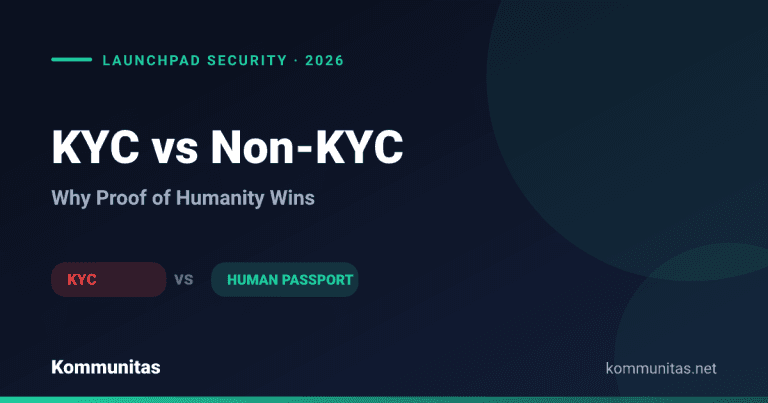
tl;dr: KYC launchpads verify your government ID before you can join a token sale — good for regulatory cover, bad for privacy, speed, and global access. Non-KYC launchpads skip ID collection but historically struggled with Sybil attacks (one person faking hundreds of wallets). The modern fix isn't "KYC vs anonymity" anymore — it's proof of humanity. Kommunitas uses Human Passport to confirm you're a unique real person without ever collecting your passport photo or personal data, unlocking fair universal-sale access with none of the KYC friction.
Every crypto launchpad has to answer one question before letting you into an IDO: how do we know you're a real, unique participant and not a bot farm? For years there were only two answers — collect everyone's ID (KYC), or collect nothing and hope for the best (non-KYC). Both come with real trade-offs. This guide breaks down each model honestly, then explains why a third approach — cryptographic proof of humanity — is quietly making the old debate obsolete.
What KYC Actually Means on a Launchpad
KYC ("Know Your Customer") means the platform asks you to upload identity documents — passport, national ID, sometimes a selfie or liveness check — before you can participate in a sale. A third-party verifier confirms the documents are genuine, and only then does your wallet get whitelisted.
The upside is regulatory: KYC helps platforms comply with anti-money-laundering (AML) rules and reassures institutional partners. It also raises the cost of Sybil attacks, because faking hundreds of verified identities is harder than spinning up hundreds of empty wallets.
The Real Costs of KYC
KYC's problems are practical, not theoretical. You hand your most sensitive personal data to a platform (and its verification vendor), creating a honeypot that can leak — crypto KYC databases have been breached before. Verification can take hours or days, so fast-moving sales close before you're approved. And plenty of jurisdictions get geo-blocked outright, locking out legitimate users purely by passport. For a space built on permissionless access, requiring a passport to join a public token sale is a real contradiction.
What Non-KYC Means — And Why It Wasn't Enough
A non-KYC launchpad lets you participate with just a wallet — no documents, no waiting, no geo-gates. That's the permissionless ideal: anyone, anywhere, instantly.
The historical weakness is the Sybil attack. Without any way to tell one human from a thousand fake wallets, allocations get drained by bots and whales running scripts. The people the model was meant to protect — ordinary retail investors — end up with less, because a single actor can flood the sale with hundreds of addresses. That's why "non-KYC" alone earned a reputation for unfair, bot-dominated launches.
The Third Way: Proof of Humanity Instead of Identity
Here's the insight that breaks the old binary: you don't actually need someone's identity to run a fair sale. You just need proof they're a unique human. Those are different problems, and solving the second one doesn't require solving the first.
That's what Human Passport does. It uses onchain and offchain signals to build a humanity/uniqueness score for your wallet — confirming you're one real person — without collecting your passport, ID, or personal data. The result is Sybil resistance (the main benefit of KYC) with the privacy and open access of non-KYC. It sits in a growing category of KYC alternatives designed for exactly this.
KYC vs Non-KYC vs Proof of Humanity: 5-Point Comparison
1. Privacy
KYC: Worst. You surrender government ID, and sometimes a selfie, to the platform and its verification vendor. Non-KYC: Best. No documents collected at all. Proof of humanity: Near-best. No personal documents collected — only a uniqueness score is generated.
2. Sybil Resistance
KYC: Strong. Faking hundreds of verified identities is expensive and slow. Non-KYC: Weak. Nothing stops one actor from running hundreds of wallets. Proof of humanity: Strong — the same resistance as KYC, without the ID honeypot.
3. Speed and Access
KYC: Slow and geo-restricted. Verification can take hours to days, and entire countries get excluded. Non-KYC: Instant and global. Proof of humanity: Fast and global — no document review queue, no passport-based exclusion.
4. Fair Allocation
KYC: Fair but gated behind the ID requirement. Non-KYC: Exposed to bot farming — allocations skew toward whoever runs the most wallets. Proof of humanity: Fair and open — one verified human, one fair shot, without a document gate.
5. Regulatory Posture
KYC: Strongest AML cover for platforms that need it. Non-KYC and proof of humanity: posture depends on jurisdiction and how the specific sale is structured — always do your own due diligence on the platform's compliance approach.
How Kommunitas Applies This: Fair Universal Sale
Kommunitas doesn't gate its sales behind document uploads. Instead, humanity verification via Human Passport powers a universal sale model — where a confirmed unique participant gets fair access to allocation regardless of nationality or how much capital they can throw at the sale. Combined with a tierless allocation design, it means a small holder isn't crowded out by whales or bot armies. If you want the practical mechanics, see how to get whitelisted for an IKO on Kommunitas.
Which Model Should You Look For as an Investor?
If your priority is institutional-grade AML compliance and you don't mind the friction, a KYC launchpad is defensible. But if you value privacy, speed, and global access — and you still want protection from bot-dominated sales — a platform using proof of humanity gives you the best of both worlds. The key question to ask any launchpad isn't "do you do KYC?" but "how do you stop one person from faking a thousand wallets without harvesting my personal data?"
FAQ
Is a non-KYC launchpad illegal or unsafe?
Not inherently. Non-KYC simply means the platform doesn't collect your identity documents. Legality depends on jurisdiction and how the sale is structured, and safety depends on the platform's Sybil resistance and smart-contract security — not on whether it takes your passport. Always do your own due diligence on the project and the platform.
Does Human Passport store my personal data?
No. Human Passport verifies that you are a unique human using onchain and offchain signals to build a humanity score — it does not require or store government ID documents or personal identity data the way traditional KYC does. That's the whole point: Sybil resistance without an ID honeypot.
Why do KYC launchpads geo-block some countries?
Because KYC ties participation to regulatory jurisdictions. To stay compliant with AML rules, platforms often exclude entire countries, which locks out legitimate users purely based on their passport. Proof-of-humanity models avoid this by verifying uniqueness rather than nationality.
Can bots get past Human Passport?
It's designed to make Sybil attacks far harder and more expensive. By scoring for genuine human uniqueness rather than just wallet count, it prevents a single actor from flooding a sale with hundreds of fake addresses — the exact failure mode that hurt early non-KYC launchpads.
What's the fastest way to tell if a launchpad uses KYC, non-KYC, or proof of humanity?
Check the whitelisting step before a sale. If it asks for a passport or selfie upload, it's KYC. If it only asks you to connect a wallet with zero verification, it's non-KYC. If it asks you to complete a quick humanity/uniqueness check (like Human Passport) without ever requesting a government document, it's the proof-of-humanity model.
Conclusion
The "KYC vs non-KYC" debate framed launchpads as a choice between compliance and privacy. That framing is outdated. Proof of humanity — like the Human Passport model Kommunitas uses — delivers the Sybil resistance that made KYC useful while keeping the privacy, speed, and open access that made non-KYC attractive. For retail investors who just want a fair shot at an allocation without surrendering their ID, that third path is the one worth looking for.
Related Reading
- How Human Passports Are Equalizing Web3 Crowdfunding
- Web3 Crowdfunding Anonymity: New KYC Alternatives
Disclaimer: This article is for educational and informational purposes only and is not financial, legal, or investment advice. Regulatory treatment of KYC and non-KYC platforms varies by jurisdiction and can change. Always do your own research (DYOR) before participating in any token sale.