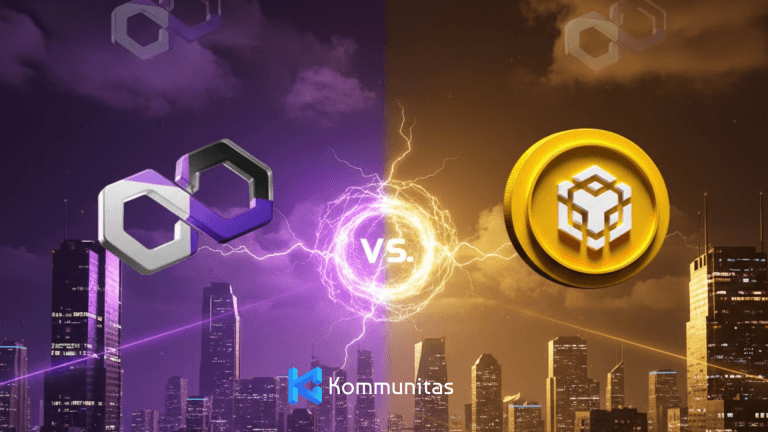
As we navigate through 2026, the blockchain power map is divided into two major poles: Polygon, which has transformed into an "Aggregated Network" (AggLayer), and Binance Smart Chain (BSC), which has solidified its position as the king of CeDeFi (Centralized-Decentralized Finance).
While both Polygon and the BNB Smart Chain (BSC) serve as the primary "highways" for modern IDO launchpads, they offer distinct experiences for both developers and investors. Polygon operates as an Ethereum Layer 2 scaling solution (now enhanced by its 2026 "AggLayer" technology), prioritizing deep security and seamless interoperability with the Ethereum mainnet. In contrast, the BNB Smart Chain is a high-speed, independent Layer 1 blockchain that leverages the massive liquidity and user base of the Binance ecosystem.
Understanding these differences is crucial for investors and developers looking to mitigate infrastructure risks.
1. Network Architecture: Aggregation vs. Centralized Efficiency
Polygon: The Internet of Blockchains
In 2026, Polygon is no longer a single chain. Through the AggLayer, it allows liquidity to flow seamlessly between Polygon PoS, App-chains, and zk-Rollups. If you prioritize long-term security and Ethereum alignment, Polygon is the clear choice.
BSC: The CeDeFi Powerhouse
BSC remains the primary choice for those seeking sheer efficiency. With the full backing of the Binance exchange, it offers the smoothest "on-ramp/off-ramp" for new users. BSC functions like a well-managed private highway: incredibly fast, but more centralized in its governance.
2. Tokenomics: POL vs. BNB
In 2026, these two tokens play very different roles in an investor’s portfolio:
POL (Polygon): The "hyperproductive" token. POL is not just for gas fees; it is used to validate multiple chains simultaneously within the Polygon ecosystem. This provides broad utility as the number of "App-chains" grows.
BNB (Binance): Operates with an aggressive Auto-Burn mechanism, making it a strong deflationary asset. BNB’s utility extends beyond the blockchain, covering trading discounts on the Binance exchange, Launchpad participation, and global payment integrations.
3. Ecosystem and Use Cases
Where Polygon Leads:
Enterprise & RWA: Large corporations (like Nike, Starbucks, and global banks) prefer Polygon due to its compliance with Ethereum standards and Zero-Knowledge (ZK) security.
Gaming & NFTs: With near-zero minting costs and ZK-finality, Polygon has become the home for AAA Web3 games in 2026.
Where BSC Leads:
Retail DeFi: For daily users wanting cheap swaps and deep liquidity, PancakeSwap and the BSC DeFi ecosystem remain hard to beat.
Mass Adoption: Thanks to integration with the Binance app, BSC is the first entry point for millions of new users through user-friendly features.
4. Security and Risk: What to Watch For
To maintain Trustworthiness, one must understand the risks associated with each:
Polygon Risks: The technical complexity of the transition to Polygon 2.0 and the AggLayer can be a hurdle for novice developers. Furthermore, its reliance on Ethereum means if Ethereum faces an issue, Polygon is inherently affected.
BSC Risks: Higher centralization means the network is more susceptible to global regulatory pressures targeting its central entity (Binance). While technically secure, control is held by a smaller group of validators compared to Polygon.
Based on the current 2026 landscape, Kommunitas ($KOM) has officially completed its primary migration from Polygon and Arbitrum to the BNB Smart Chain (BSC). This move was finalized in July 2025, making BSC the main "home" for the $KOM token.
If you still hold $KOM on Polygon and need to move it to BSC, here is the expert research on how to do it safely and the status of Kommunitas' swap tools.
How to Move $KOM Assets (Polygon to BSC)
Since $KOM is now primarily a BSC-native token, moving your assets is not a standard "bridge" but a Token Migration/Swap. You have two primary methods:
Method A: The Official Manual Swap (Recommended)
Kommunitas has disabled self-bridging to prevent errors and liquidity issues. We now provide a Manual Swap Portal.
Official Link: kommunitas.net/swap
Process: You fill out a request form, send your Polygon $KOM to the designated treasury address, and the team manually sends the new BSC $KOM to your wallet.
SLA: Processing typically takes a maximum of 48 hours.
Method B: Using Centralized Exchanges (CEX)
If your $KOM is on a CEX like MEXC, the migration was likely handled automatically in mid-2025.
Step: Deposit your old Polygon $KOM to the exchange (if they still support the old deposit address).
Withdraw: Select the BEP-20 (BSC) network when withdrawing to your private wallet.
Note: Check the exchange's announcement page first; most exchanges like MEXC stopped supporting "Old KOM" deposits after July 2025.
Our launchpad now encourages using wallets that support "one-click" cross-chain swaps like Rabby or OKX Wallet.
Conclusion: Which Should You Choose?
The choice between Polygon and BSC in 2026 depends on your specific goals:
Choose Polygon if you are building or investing in projects that require high-level security, cross-chain interoperability, and Ethereum-native alignment.
Choose BSC if you prioritize transaction speed, instant retail liquidity, and integration with the world’s largest exchange ecosystem.
Despite our launchpad now uses Cross-Chain Payment Tools, allowing you to pay with Polygon USDT but receive project tokens on the project's native chain automatically, we recommend to swap your Polygon KOM to BSC.
Next Step: Ensure your digital wallet (Rabby Wallet, OKX, MetaMask, etc.) is updated with the latest RPC settings for both networks to avoid transaction failures during the 2026 network upgrade periods.