
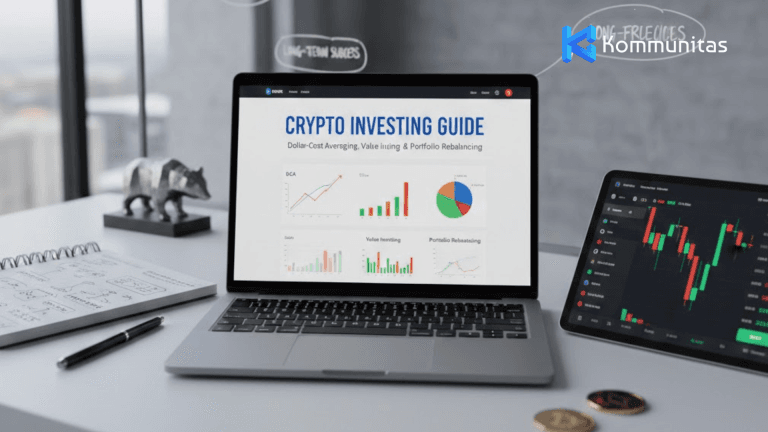
The world of digital assets offers unparalleled opportunities, but the volatility of the crypto market demands a structured, disciplined approach. You can't just throw money at the latest meme coin and expect a comfortable retirement. To truly succeed in the long term, you need a robust crypto invest strategy.
This crypto investing guide dives deep into proven crypto investment strategies.. We'll detail the mechanics of three core strategies—Dollar-Cost Averaging (DCA), Value Investing, and Portfolio Rebalancing—and explain which one is right for your risk tolerance.
Your Three Core Crypto Investing Strategies
Mastering the cryptocurrency market means moving beyond mere speculation and adopting mechanical, goal-oriented strategies. Here are three methods that form the foundation of intelligent crypto investing:
1. Dollar-Cost Averaging (DCA): The Anti-Volatility Tool
The Mechanics of DCA
Dollar-Cost Averaging (DCA) is perhaps the simplest and most accessible crypto investment strategy. Instead of trying to time the market—a feat even professionals struggle with—DCA involves investing a fixed dollar amount into a specific cryptocurrency (or basket of cryptos) at regular, predetermined intervals.
How it Works: You decide to invest, say, $100 every Tuesday, regardless of whether Bitcoin (BTC) is at $60,000 or $40,000.
When the price is high, your $100 buys fewer units.
When the price is low, your $100 buys more units.
The Result: Over time, this mechanical approach averages out your purchase price, smoothing the impact of market volatility and often resulting in a lower average cost per unit than a single, poorly timed lump-sum purchase.
Read Also Cryptocurrency Concept
When to Employ DCA
DCA is the perfect strategy for:
Risk-Averse Investors: By spreading out your entry, you minimize the risk of a major loss from buying at a temporary market peak. It's a psychological shield against emotional, panic-driven investing.
Long-Term 'HODLers': If your goal is to steadily accumulate assets over 5+ years, DCA provides a disciplined path to wealth building.
Investors with Recurring Income: It seamlessly integrates with a monthly or bi-weekly paycheck, allowing you to invest new funds immediately and consistently.
2. Value Investing (Fundamental Analysis): Seeking Undervalued Gems
The Mechanics of Value Investing
Inspired by traditional investors like Warren Buffett, crypto value investing involves performing in-depth fundamental analysis to identify digital assets whose market price is currently below their intrinsic value.
In the volatile crypto world, this value is assessed not by earnings reports, but by:
Technology & Use Case: Does the project solve a real-world problem (e.g., decentralized identity, supply chain tracking, secure layer-one settlement)?
Team & Community: Who are the developers? Is the project roadmap being met? Is the community active and engaged?
Tokenomics: How is the token distributed? What is its maximum supply? Does the token accrue value as the network grows (utility)?
Network Metrics: On-chain data like active user addresses, transaction volume, and development activity.
How it Works: A value investor believes a particular coin is currently trading at $1.00, but their analysis shows its underlying technology and adoption potential justify a value of $5.00. They invest a significant capital sum (or use DCA into that position) with the expectation that the market will eventually recognize its true value.
When to Employ Value Investing
This strategy requires considerable effort and a high degree of confidence in your research:
Moderate-to-High Risk Tolerance: You must be comfortable with the potential for an undervalued asset to remain undervalued for a long time, or even fail completely, if your analysis is wrong.
Experience & Knowledge: This is suited for those with the expertise to read whitepapers, understand complex protocol mechanics, and analyze on-chain data.
Cyclical Investors: Value investors often see bear markets as the best time to buy, as the "fear" in the market pushes the prices of fundamentally strong projects down to attractive levels.
3. Portfolio Rebalancing: The Risk Manager
The Mechanics of Portfolio Rebalancing
Portfolio rebalancing is not an initial buying strategy, but a crucial management strategy. It ensures your portfolio's risk level remains constant by returning your asset allocation back to its original target weights at regular intervals.
Initial Setup: You decide on a target allocation, for example:
60% Bitcoin (BTC)
30% Ethereum (ETH)
10% Smaller Altcoins (High Risk)
Market Growth (The Drift): A strong bull run happens. BTC and ETH outperform the altcoins. Your portfolio drifts to:
75% Bitcoin (BTC)
20% Ethereum (ETH)
5% Smaller Altcoins
Rebalancing Action: Your portfolio is now significantly riskier (more concentrated in BTC). To rebalance, you:
Sell: A portion of the outperforming assets (BTC, in this case).
Buy: More of the underperforming assets (ETH and Altcoins).
The Result: You lock in profits from the winners and buy assets "on sale," returning your portfolio to the 60/30/10 target and resetting your risk level.
Read Also Crypto Whitepaper
When to Employ Portfolio Rebalancing
This is a mandatory step for long-term investors across the entire risk spectrum:
Controlling Risk: It prevents a runaway asset from dictating your entire portfolio's performance, ensuring you never become over-exposed to a single risk.
Forceful Profit-Taking: It mechanically forces you to sell high and buy low, overriding the human tendency to hold winners too long and avoid buying assets that have recently dropped.
Any Investor: Whether you DCA, value invest, or use a combination, regular rebalancing (quarterly or semi-annually) is a necessity for managing a long-term crypto invest strategy.
Matching Your Strategy to Your Risk Tolerance
Your personal risk tolerance is the most important factor in choosing your crypto investment strategies.
Investing Takeaways
This crypto investing guide is designed to be highly reliable and valuable. By focusing on proven, disciplined strategies like DCA, Value Investing, and Rebalancing, you can establish a systematic crypto invest strategy that sets you up for long-term success.
Remember: Never invest more than you can afford to lose, and always do your own research (DYOR).These strategies are tools for discipline, not guarantees of profit.
Want to get in early? Discover and join early token sales on Kommunitas IDO launchpad.