
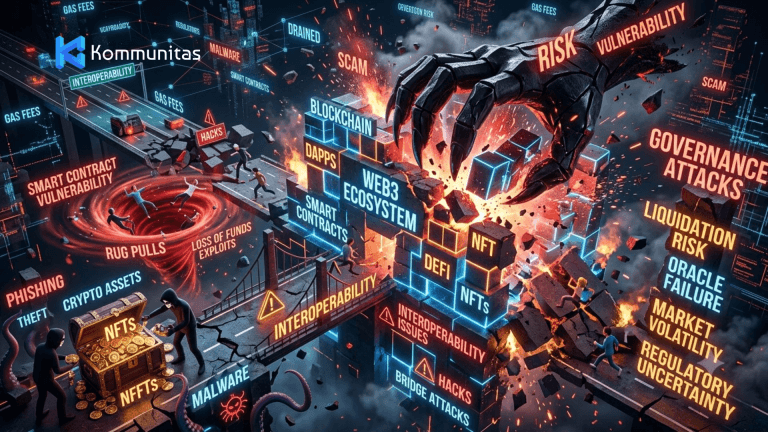
Spotting the common red flags in web3 launch platforms early is the single best way to protect your capital before a launch even opens. The Web3 industry has matured far beyond the era where a polished whitepaper and viral social media hype were enough to justify investor confidence. Today’s crypto market is filled with increasingly sophisticated fundraising structures, complex token economies, and launch ecosystems designed to attract retail capital at scale. Unfortunately, the same infrastructure enabling decentralized innovation also enables manipulation, unsustainable economics, and coordinated extraction from uninformed participants.
Most retail investors do not lose money because they failed to discover opportunities. They lose money because they failed to identify structural risk early enough.
After reviewing hundreds of token launches, public sale structures, staking systems, and GameFi economies across multiple market cycles, one pattern becomes consistently clear:
The majority of catastrophic Web3 failures show visible warning signs long before collapse occurs.
The problem is that many investors only evaluate narrative momentum:
- “Is the community active?”
- “Did influencers promote it?”
- “Will the token pump after listing?”
Far fewer investigate:
- Who controls token supply?
- How emissions are managed
- Whether smart contracts can be altered
- Who holds treasury authority
- Whether refund protection exists
- How insiders unlock compared to retail buyers
This guide breaks down the most important red flags across four critical layers of Web3 investing:
- Token sale structures
- Metaverse and GameFi tokenomics
- Launchpad due diligence systems
- Staking and passive yield mechanisms
More importantly, it introduces a practical framework retail investors can use to evaluate projects before capital deployment.
The 5-Layer Web3 Risk Matrix
Before evaluating any project, it helps to separate hype from infrastructure risk.
A strong narrative does not compensate for weak economic architecture.
The following framework can be used across IDOs, ICOs, GameFi projects, AI tokens, metaverse ecosystems, and staking platforms.
Risk Layer | What to Analyze | Common Failure Pattern |
Contract Risk | Smart contract permissions, audits, upgradeability | Hidden admin control or exploitable logic |
Treasury Risk | Treasury wallet visibility and fund control | Insider-controlled wallets with no accountability |
Liquidity Risk | Unlock schedules and liquidity depth | Early insider exits causing price collapse |
Emission Risk | Token inflation and staking rewards | Hyperinflationary rewards without sinks |
Governance Risk | Voting power and protocol authority | Centralized teams overriding community decisions |
Most failed projects trigger warnings in multiple layers simultaneously.
For example, the collapse of Terra was not caused by a single event. It involved:
- unsustainable yield dependency,
- fragile token stabilization mechanics,
- reflexive liquidity loops,
- and excessive confidence in perpetual growth assumptions.
Likewise, many failed GameFi ecosystems did not collapse because users stopped playing. They collapsed because token emissions dramatically exceeded organic demand.
1. Red Flags in Token Sale Structures
Token sales are often marketed as “community-driven fundraising,” but the actual allocation mechanics frequently favor insiders over public participants.
The most dangerous warning signs are usually hidden inside vesting schedules, treasury rights, and legal clauses.
Asymmetric Unlock Structures
One of the clearest indicators of structural imbalance occurs when:
- private investors unlock immediately,
- advisors receive short cliffs,
- while public buyers face long vesting periods.
This creates a predictable liquidity imbalance.
Retail participants effectively become exit liquidity for earlier capital rounds.
A healthier structure typically includes:
- multi-month cliffs for insiders,
- linear unlock schedules,
- and transparent wallet tracking.
Projects that avoid publishing insider wallet addresses should immediately raise suspicion.
Refund Clauses That Remove Accountability
Legitimate fundraising systems acknowledge execution risk.
Projects fail. Delays happen. Market conditions change.
However, many token sales now include clauses that:
- remove refund eligibility entirely,
- give teams unilateral authority,
- or provide no treasury accountability after fundraising concludes.
This becomes especially dangerous when launchpads also lack escrow enforcement.
One recurring pattern during failed launches is that retail participants absorb 100% of downside risk while teams retain unrestricted treasury access.
That imbalance matters more than marketing quality.
Offshore Structures With No Jurisdictional Clarity
Many projects intentionally establish vague legal entities in offshore regions with minimal enforcement obligations.
This alone does not prove malicious intent.
However, if a project simultaneously has:
- anonymous founders,
- unaudited contracts,
- no multisig treasury,
- and unclear legal structure,
the aggregate risk increases substantially.
Strong projects reduce uncertainty wherever possible.
Weak projects stack opacity across every layer.
2. Red Flags in Metaverse and GameFi Tokenomics
The collapse of many Play-to-Earn ecosystems revealed a harsh reality:
User growth alone cannot sustain a token economy.
Several GameFi ecosystems experienced explosive adoption during bullish periods, only to collapse once new capital inflows slowed down.
The underlying issue was usually emission imbalance.
Hyperinflationary Reward Systems
A common failure pattern looks like this:
- Users earn tokens rapidly
- Selling pressure increases
- Token price declines
- More tokens are emitted to maintain rewards
- Inflation accelerates further
Without effective economic sinks, the system eventually breaks.
Healthy token economies typically include:
- upgrade costs,
- marketplace fees,
- asset crafting,
- governance staking,
- or permanent token burns.
If a token is primarily created to reward users — but lacks meaningful mechanisms to remove supply — inflation becomes inevitable.
The implosion of many early GameFi economies demonstrated this clearly, including issues observed in portions of the Axie Infinity reward structure during its high-emission expansion phase.
Insider Supply Concentration
Many retail investors ignore token distribution charts entirely.
This is a mistake.
A project can have:
- excellent branding,
- high engagement,
- aggressive partnerships,
while still being structurally vulnerable because insiders control excessive supply.
Large insider allocations are not automatically malicious.
But investors should carefully evaluate:
- vesting duration,
- circulating supply ratios,
- treasury transparency,
- and wallet concentration.
If a small number of wallets can materially affect market liquidity, volatility risk rises significantly.
3. Red Flags in Web3 Launch Platforms
Launchpads act as trust intermediaries between early-stage projects and retail participants.
That means weak launchpad standards often produce weak project quality.
Audit Theater Instead of Real Security Review
Some platforms advertise “audited projects” even when:
- audits are outdated,
- limited in scope,
- or conducted by low-reputation firms.
An audit should never be treated as absolute protection.
Instead, investors should verify:
- whether findings were resolved,
- whether contracts changed post-audit,
- and whether upgrade permissions still exist.
Security firms such as CertiK and Hacken can improve confidence, but audit quality still varies substantially.
Fake Liquidity and Manufactured Metrics
Some launch ecosystems inflate:
- Total Value Locked (TVL),
- user participation,
- transaction counts,
- or staking volume.
Artificial liquidity can temporarily create the illusion of market strength.
Cross-checking data across:
- on-chain explorers,
- treasury wallets,
- DEX liquidity,
- and independent analytics platforms
is essential before participating in any public raise.
When platform metrics look dramatically disconnected from actual social activity or on-chain usage, skepticism is healthy.
No Investor Protection Infrastructure
One of the most overlooked differences between launchpads is how they manage downside risk.
Questions investors should ask:
- Are funds released through milestones?
- Is refund protection available?
- Are treasury wallets transparent?
- Is KYC enforced for founders?
- Can projects disappear immediately after fundraising?
Retail protection mechanisms matter far more during bear markets than bull markets.
Anyone can appear competent during euphoric liquidity conditions.
4. Red Flags in Staking and Yield Platforms
High APY alone is not proof of fraud.
But mathematically unsustainable rewards almost always create long-term instability.
Unsustainable Yield Dependency
If staking rewards significantly exceed:
- protocol revenue,
- transaction fee generation,
- or realistic inflation control,
then rewards are likely subsidized through token dilution alone.
This creates temporary attraction but long-term selling pressure.
The most dangerous systems depend entirely on continuous new participant inflows to sustain valuation.
Once growth slows, emissions overwhelm demand.
Hidden Administrative Functions
Retail investors rarely inspect smart contract permissions directly.
Attackers know this.
Historically, multiple exploits and rug pulls involved:
- unrestricted mint functions,
- migrator permissions,
- emergency withdrawal abuse,
- or upgradeable contracts controlled by a single wallet.
Before staking assets, investors should verify:
- whether contracts are verified publicly,
- whether multisig protection exists,
- and whether admin privileges remain active.
Platforms hiding contract source code should immediately be treated as high risk.
A Practical Due Diligence Workflow
Instead of relying on hype cycles or influencer sentiment, investors should adopt a repeatable screening process.
Step 1 — Verify Infrastructure
Check:
- smart contract audits,
- GitHub activity,
- multisig wallets,
- treasury transparency,
- and contract verification.
Step 2 — Analyze Economic Sustainability
Evaluate:
- emissions,
- unlock schedules,
- circulating supply,
- insider concentration,
- and revenue generation.
Step 3 — Assess Accountability
Determine:
- whether refunds exist,
- whether governance is decentralized,
- whether treasury movement is visible,
- and whether founders remain publicly accountable.
Projects that fail all three layers rarely survive long-term market stress.
What Experienced Investors Usually Prioritize
Across multiple market cycles, experienced participants consistently focus on:
- treasury transparency,
- token unlock schedules,
- smart contract permissions,
- and liquidity structure
far more than influencer engagement.
Because in Web3, collapse rarely arrives without warning.
The warning signs are usually visible on-chain first.
Final Thoughts
Web3 investing is no longer just about finding narratives early.
It is about identifying structural resilience before capital enters the system.
Strong projects reduce uncertainty:
- transparent treasury management,
- balanced token emissions,
- enforceable vesting,
- audited contracts,
- and accountable governance.
Weak projects rely on:
- hype,
- opacity,
- unrealistic yields,
- and retail FOMO.
The difference becomes obvious once you learn where to look.
For investors participating in early-stage fundraising ecosystems, risk evaluation is not optional. It is the core skill that determines long-term survival in decentralized markets.
Frequently Asked Questions (FAQ)
What is the most critical red flag in token sale terms and conditions?
The most critical red flag is the absence of an automated refund mechanism coupled with asymmetric vesting terms that favor insiders over the public. If founders can liquidate their tokens immediately while public buyers are locked, the project carries an extremely high risk of a coordinated dump.
How can I verify if metaverse tokenomics are sustainable?
Analyze the project's whitepaper for verifiable "economic sinks"—use cases where tokens are permanently burned or taken out of circulation via true utility. If a token's only purpose is to buy assets that generate more tokens, the asset is hyperinflationary and structurally unsustainable.
Why should I avoid Web3 launch platforms that don't enforce refund windows?
Launch platforms without strict refund or insurance protection shift 100% of the project-failure risk onto retail participants. Reputable launchpads enforce safeguards to hold incoming projects accountable for their post-launch token performance.
Capital Protection Through Accountable Innovation
Web3 security is completely holistic. As a strategic investor, you cannot afford to evaluate a project through a single lens. By systematically screening for vulnerabilities within token sale terms and conditions, assessing the sustainability of metaverse tokenomics, choosing protected Web3 launch platforms, and avoiding predatory staking yields, you insulate your capital from systemic risks.
Always conduct thorough on-chain due diligence, favor audited code bases, and prioritize decentralized launchpads that enforce rigorous investor-protection frameworks to future-proof your digital asset portfolio. Ready to participate in early-stage Web3 opportunities backed by robust on-chain investor protections? Explore upcoming ecosystem launches and learn how to optimize your portfolio securely by checking out the Kommunitas ecosystem for a transparent, auditable chance at secure token allocations.
Disclaimers
This content is provided for informational and educational purposes only and should not be construed as financial, legal, or investment advice. Cryptocurrencies, decentralized finance (DeFi), and early-stage token allocations are subject to high market volatility and systemic smart contract risks. Investors must conduct their own independent research (DYOR) and assess their personal risk tolerance before allocating capital to any Web3 protocol or digital asset.
References
- Kommunitas Security Documentation
- Decentralized Finance Smart Contract Security Guidelines (CertiK & Hacken Security Standards)