
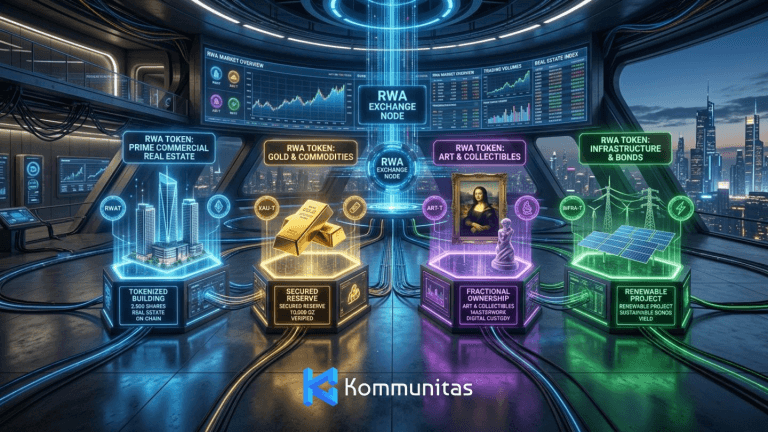
Imagine owning a fraction of a high-yield commercial building in New York, a portion of a gold bar secured in a Swiss vault, or a share of short-term U.S. Treasury bills—all sitting safely in your crypto wallet. This isn't a futuristic concept; it is the reality of Real World Asset (RWA) tokenization. As decentralized finance (DeFi) matures past speculative meme coins and volatile yield-farming loops, the integration of tangible, real-world value onto the blockchain is triggering a massive structural shift.
For everyday investors, this evolution is a game-changer. Historically, high-yield, premium financial instruments were locked behind institutional walls, reserved exclusively for accredited investors with massive capital. RWA tokenization shatters these barriers. By converting the rights to a physical or financial asset into a digital token on a blockchain, the crypto ecosystem is introducing unprecedented liquidity, fractional ownership, and global access to traditional markets.
What is RWA Tokenization in DeFi?
Real World Asset (RWA) tokenization is the process of converting ownership rights of a physical or traditional financial asset into a digital token on a blockchain. By utilizing smart contracts, these tokens represent fractional shares of tangible assets—such as real estate, commodities, private equity, or government bonds—bringing institutional-grade security, transparency, and liquidity to the decentralized finance (DeFi) ecosystem.
This bridge between traditional finance (TradFi) and DeFi solves a structural problem for both sides. TradFi is notoriously slow, plagued by middleman fees, and bound by rigid operating hours. DeFi, while fast and permissionless, has historically suffered from native crypto volatility. Bringing RWAs on-chain introduces stable, yield-bearing assets to the blockchain, offering a sustainable foundation for the future of inclusive finance.
The Core Pillars of the RWA Revolution
To understand why institutional giants and retail investors are rushing toward tokenization, it helps to look at the mechanical advantages that blockchain technology provides to traditional assets.

1. Fractional Ownership and Democratic Access
The most immediate benefit of tokenization is the ability to split an asset into millions of tiny pieces. If a prime piece of real estate costs $10 million, the average retail investor is completely priced out. However, if that property is tokenized into 1 million tokens worth $10 each, anyone can participate.
This ethos of democratization mirrors the philosophy of a Tierless Crypto Launchpad, where the goal is to remove arbitrary wealth barriers and allow community members equal access to early-stage opportunities without requiring heavy capital staking.
2. 24/7 Liquidity and Instant Settlement
Traditional asset markets operate on rigid schedules—opening at 9 AM and closing at 4 PM, completely shutting down on weekends. Settlement times can take anywhere from two to five business days ($T+2$ or $T+5$). Tokenized assets operate on public blockchains, enabling global, peer-to-peer trading 24 hours a day, 7 days a week, with transactions settling in seconds.
3. Radical Transparency and Programmatic Compliance
On-chain assets eliminate the reliance on opaque bookkeeping. Every token issuance, transfer, and dividend distribution is immutably recorded on the ledger. Furthermore, compliance mechanisms—such as Know Your Customer (KYC) checks and regional selling restrictions—can be hardcoded directly into the token's smart contract, ensuring the asset cannot be traded to a non-compliant wallet.
Key RWA Asset Classes Dominating the Market
The scope of tokenization spans across almost every valuable asset class on earth. Currently, a few sectors are leading the charge in total value locked (TVL) and investor adoption:
Tokenized Public Debt (U.S. Treasuries): In an environment with elevated traditional interest rates, tokenized government bonds have exploded. They allow non-U.S. investors and crypto-native DAOs to park their capital in low-risk, yielding instruments directly on-chain.
Real Estate and Infrastructure: Fractionalized rental properties allow investors to pool capital, buy real estate assets collectively, and receive automated rental yields distributed proportionally to their Web3 wallets via smart contracts.
Commodities and Hard Assets: Tokenized precious metals allow users to hold the upside of physical commodities without worrying about the logistics, storage fees, or security risks of physical custody. Understanding how blockchain handles physical backing highlights how Assetbacked Crypto transforms volatile portfolios into stable, yield-generating wealth vehicles.
Comparing Traditional Assets vs. Tokenized RWAs
A Step-by-Step Workflow: How a Physical Asset Moves On-Chain
The process of taking a tangible asset and placing it onto a decentralized ledger requires a careful blend of legal engineering and blockchain architecture. Here is the standard workflow:
Step 1: Asset Acquisition and Valuation
A specialized entity (the issuer) identifies a physical asset, such as an apartment complex. The asset is legally appraised to establish its fair market value, and the legal ownership is typically placed inside a Special Purpose Vehicle (SPV)—a dedicated legal entity designed solely to hold the asset.
Step 2: Legal and Regulatory Structuring
Attorneys draft the regulatory framework governing the asset. This ensures that the digital tokens legally bind the holder to the economic benefits of the physical asset (such as dividend payouts or property appreciation) and comply with local securities laws.
Step 3: Smart Contract Creation and Tokenization
Developers write the smart contracts that dictate how the tokens behave. These contracts define the total token supply, fractional pricing, distribution schedules, and embedded compliance rules (like mandatory KYC whitelisting).
Step 4: On-Chain Launch and Distribution
The tokens are minted and launched to the public. For projects bringing physical utility or decentralized infrastructure networks to Web3, launching through an equitable Crypto Launchpad ensures that the initial token distribution is fair, decentralized, and entirely free from whale manipulation.
Step 5: Secondary Market Trading and Asset Management
Once distributed, the RWA tokens trade freely on decentralized applications (dApps). If the underlying asset generates revenue—like monthly rent or bond coupons—the smart contract automatically distributes these yields in stablecoins directly to the token holders' wallets.
Why This Matters for the Future of Inclusive Finance
The rise of RWAs signals that crypto is moving past its insular phase. It is no longer just about trading tokens backed by nothing more than community sentiment. By grounding blockchain technology in real-world utility, DeFi is constructing a financial ecosystem that is resilient, sustainable, and useful to the average global citizen.
This transition closely aligns with the broader push for structural fairness in Web3. For years, retail investors were locked out of both premium real-world assets and premium early-stage crypto allocations due to restrictive capital tier systems. The convergence of RWA fractionalization and democratized launchpad systems ensures that anyone—regardless of geographic location or portfolio size—can build a diversified, institutional-grade investment portfolio completely on-chain.
Frequently Asked Questions (FAQ)
1. What happens to the token if the physical asset is damaged or stolen?
The digital token represents a legal claim on the asset held by a legal entity (like an SPV). The physical assets themselves are typically backed by traditional insurance policies, custodians, and legal safeguards managed by the token issuer to protect the token holders' underlying value.
2. Do I need to undergo KYC verification to buy RWA tokens?
In most cases, yes. Because real-world assets are bound by traditional securities regulations, issuers must ensure that buyers are legally compliant. The smart contracts of modern RWA tokens are programmed to only allow transfers between wallet addresses that have completed verified KYC verification.
3. How do token holders receive yield from real-world assets?
Yields—such as interest payments from bonds or rental income from real estate—are typically converted into stablecoins (like USDC or USDT) by the managing issuer. These funds are then sent directly to the asset's primary smart contract, which automatically routes the payments to token holders based on the percentage of tokens they hold.
4. What is the difference between an RWA and a stablecoin?
A standard fiat-backed stablecoin is a specific type of RWA designed solely to peg its value to a currency (like $1.00 USD). Broadly speaking, RWAs include assets designed to fluctuate in value, generate variable yield, or represent ownership in physical items, like real estate or gold.
Conclusion: The Horizon of Decentralized Wealth
The tokenization of Real World Assets is bridging the gap between traditional asset security and decentralized efficiency. By stripping away the gatekeepers, high capital requirements, and administrative delays of TradFi, RWAs are laying down the tracks for a truly permissionless financial landscape.
As the borders between physical assets and digital ledgers continue to blur, staying ahead of early-stage trends and structural market shifts is key to navigating the space successfully. To explore how decentralized ecosystems are lowering financial barriers and to participate in the next generation of fair-access Web3 projects, connect with the global community on the Kommunitas Telegram and monitor upcoming decentralized offerings on our platform.
Disclaimer: This article is provided for informational and educational purposes only. It does not constitute financial advice, investment recommendations, or an endorsement of any specific digital asset, platform, or financial instrument. Cryptocurrencies and tokenized real-world assets carry inherent risks, including smart contract vulnerabilities, regulatory shifts, and capital loss. Always perform your own thorough research and consult with a certified financial advisor before making any investment decisions.
References
Understanding On-Chain Asset Structures - Boston Consulting Group (BCG) Tokenization Report
The Evolution of Yield in Decentralized Finance - Chainlink RWA Analytics
Institutional Adoption of Digital Assets - BlackRock Digital Assets Framework