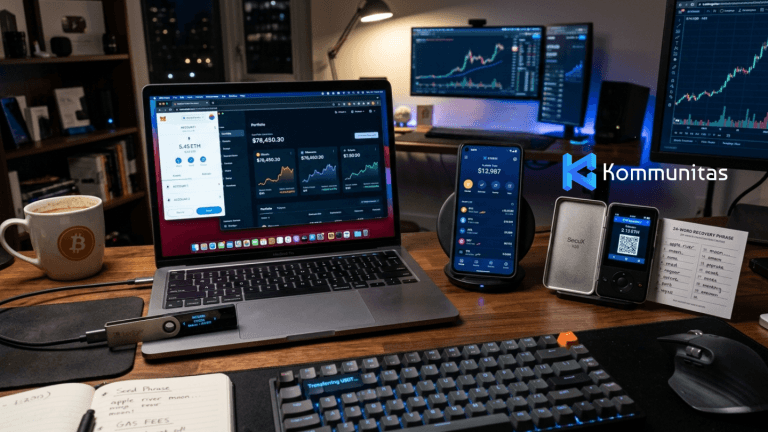
I've been in crypto long enough to remember juggling five different wallets just to manage assets across ETH, BNB Chain, and Solana. It was a mess — wrong network errors, lost gas fees, and the constant anxiety of one misclick sending funds into the void.
These days, multi-chain wallets have gotten dramatically better. Whether you're a DeFi degen hopping between protocols, an NFT collector spanning multiple ecosystems, or someone who just wants one clean app to hold everything — there's a wallet built for you.
Below is my honest breakdown of the best multi-chain wallets in 2026, tested and researched with real use in mind.
What Is a Multi-Chain Wallet, and Why Do You Need One?
A multi-chain wallet is exactly what it sounds like: a single wallet interface that lets you store, send, receive, and interact with assets across multiple blockchain networks — Bitcoin, Ethereum, Solana, BNB Chain, Avalanche, and more — all without switching apps.
The days of Ethereum dominating everything are over. Today's crypto landscape is fragmented across dozens of Layer 1s and Layer 2s, each offering different speeds, fees, and ecosystems. A good multi-chain wallet doesn't just hold your coins — it becomes your command center for navigating Web3.
"Not your keys, not your coins" — this still holds in 2026. Always choose a non-custodial wallet where only you control your private keys.
How We Evaluated These Wallets
We didn't just copy a list off the internet. Here's the criteria we weighted:
• Number of supported blockchains — more chains = more flexibility
• Security features — audits, seed phrase handling, transaction previews
• User experience — ease of setup, UI clarity, mobile vs desktop
• DeFi & dApp support — DEX swaps, staking, NFT management
• Active development — regular updates, growing ecosystem support
1. Trust Wallet — Best for Sheer Multi-Chain Breadth
🔗 Chains: 100+ | 📱 Mobile + Browser Extension | 🔓 Non-Custodial | ⭐ 4.6/5
If you want one crypto wallet that genuinely supports almost every blockchain worth caring about, Trust Wallet is your starting point. Originally built by Viktor Radchenko in 2017 and later acquired by Binance, it has grown into one of the most downloaded crypto wallets on the planet.
Trust Wallet now supports over 100 blockchains — from Bitcoin and Ethereum to Solana, Dogecoin, and Sui — and has racked up more than 220 million total downloads. With roughly 17 million monthly active users, the community is enormous, which matters when you need support or run into edge cases.
What Makes It Stand Out
• Multi-chain support spanning 100+ networks, including non-EVM chains like Bitcoin and Solana
• Built-in Web3 browser for mobile dApp access
• Security Scanner that flags suspicious contracts before you interact
• Two ISO certifications for quality and security management — rare in this space
• Hardware wallet connectivity for cold storage users
The Trade-offs
✅ Pros: Widest blockchain coverage of any hot wallet, beginner-friendly, strong security track record
⚠️ Cons: No native desktop app (browser extension only for desktop), occasional staking and transaction delay reports
Best for: Anyone who holds a diverse portfolio across many different chains and wants one app to rule them all.
2. MetaMask — The DeFi Standard
🔗 EVM Chains (Ethereum, Polygon, Arbitrum, Base + more) | 💻 Browser Extension + Mobile | 🔓 Non-Custodial | ⭐ 4.4/5
MetaMask isn't just a wallet — it's an institution. Built by ConsenSys and launched in 2016, it became the default gateway to Ethereum and EVM-compatible DeFi. With an estimated 30 million monthly active users and over 143 million total accounts created, it remains the most widely recognized Web3 wallet worldwide.
Yes, MetaMask is primarily EVM-focused — meaning it doesn't natively support Bitcoin or Solana. But if your world revolves around Ethereum mainnet, BNB Chain, Polygon, Arbitrum, Optimism, Avalanche, or Base, MetaMask is deeply integrated with virtually every dApp that matters.
What Makes It Stand Out
• Massive ecosystem — nearly every DeFi protocol, DEX, and dApp supports MetaMask first
• Built-in swaps with access to aggregated liquidity
• Staking rewards directly in-app
• MetaMask Snaps allow community-built extensions to expand functionality
• Hardware wallet integration with Ledger and Trezor
• MetaMask debit card for spending crypto
The Trade-offs
✅ Pros: Unbeatable DeFi/dApp compatibility, highly customizable, enormous developer support
⚠️ Cons: EVM-only by default, manual network switching can trip up beginners, swap fees can be higher than native DEXs
Best for: DeFi power users, NFT traders, and anyone whose activity is centered on Ethereum and EVM-compatible networks.
3. Exodus — Best for Beginners Who Want It All
🔗 100+ Chains | 💻 Desktop (Win/Mac/Linux) + Mobile | 🔓 Non-Custodial | ⭐ 4.6/5
Exodus is what crypto wallets should look like for mainstream adoption. Founded in 2015 by J.P. Richardson and Daniel Castagnoli, Exodus made a deliberate design decision: beauty and simplicity first. It paid off.
Where most wallets feel like developer tools, Exodus feels like a polished financial product. It supports over 100 networks including Bitcoin, Ethereum, Cardano, Polygon, and Solana, and its built-in exchange means you rarely need to leave the app.
The recent launch of Exodus Pay in late 2025/early 2026 pushes this further — enabling mainstream stablecoin spending directly from your wallet.
What Makes It Stand Out
• Beautiful, intuitive interface — the most visually polished wallet on this list
• Desktop support across Windows, macOS, and Linux (rare for a hot wallet)
• Built-in exchange with no account required
• Trezor and Ledger hardware wallet integration
• NFT gallery for Solana and Ethereum collectibles
• No account or personal data required
The Trade-offs
✅ Pros: Best-in-class UX, desktop-first design, suitable for complete beginners
⚠️ Cons: Swap spreads routed through third parties can be expensive, no native mobile dApp browser
Best for: Crypto newcomers, long-term holders, and anyone who values design and ease of use over advanced DeFi features.
4. Rabby Wallet — Best for DeFi Power Users
🔗 141 EVM Chains | 💻 Browser Extension + Mobile | 🔓 Non-Custodial | ⭐ 4.5/5
Rabby Wallet, built by the team behind DeBank, is what MetaMask would look like if it was rebuilt from scratch with the DeFi-native user in mind. It supports 141 EVM-compatible chains and testnets, but the real value isn't just coverage — it's how it handles security.
Before you sign any transaction, Rabby shows you a simulation: estimated balance changes, potential risks, and a clear breakdown of what you're approving. It auto-detects the correct blockchain based on the dApp you're using, eliminating the "wrong network" errors that have caused countless costly mistakes.
What Makes It Stand Out
• Auto-switches to the correct chain — no more manual network selection
• Pre-transaction risk scanning detects suspicious contracts before signing
• Detailed transaction simulations show balance changes before confirmation
• Smart contract analysis and phishing detection
• Hardware wallet support for over 20 different devices
• Open-source and regularly audited
The Trade-offs
✅ Pros: Best security features of any EVM wallet, DeFi-native UX, fully open-source
⚠️ Cons: EVM-only (no Bitcoin, Solana), no built-in fiat on-ramp, mobile app still maturing
Best for: Experienced DeFi users, on-chain analysts, and anyone who wants maximum security when interacting with smart contracts.
5. OKX Wallet — Best All-In-One Web3 Hub
🔗 100+ Chains (EVM + Non-EVM) | 💻 Mobile + Browser Extension | 🔓 Non-Custodial | ⭐ 4.5/5
OKX Wallet positions itself as a full Web3 hub rather than just a storage tool. Connected to over 100 blockchains — including both EVM and non-EVM networks like Bitcoin and Solana — it bundles a DEX aggregator, NFT marketplace, DeFi earning tools, and dApp browser into one interface.
The integration with the OKX exchange ecosystem is seamless, making it especially powerful for active traders who want to move fluidly between centralized and decentralized environments. Its limit order feature on on-chain swaps is particularly notable — a feature usually reserved for CEX trading.
What Makes It Stand Out
• Supports 100+ blockchains including Bitcoin, Ethereum, Solana, and OKX's own X Layer
• Limit order support on DEX swaps — unique for a non-custodial wallet
• On-chain analytics including liquidity pool monitoring
• Cross-chain swap functionality with bridge aggregation
• Smart Account (ERC-4337) for account abstraction features
The Trade-offs
✅ Pros: Most feature-rich wallet on this list, excellent for traders, strong cross-chain tools
⚠️ Cons: Complexity can overwhelm beginners, tied to OKX exchange ecosystem
Best for: Active traders, DeFi explorers who hop between ecosystems, and OKX exchange users who want a unified Web3 experience.
6. Bitget Wallet — Best for Scope and NFT Users
🔗 100+ Chains | 💻 Mobile + Browser Extension | 🔓 Non-Custodial | ⭐ 4.5/5
Bitget Wallet (formerly BitKeep) has quietly become one of the most comprehensive multi-chain wallets available. With over 60 million users, connections to 100+ blockchains, access to 20,000+ dApps, and trading across hundreds of DEXs and cross-chain bridges, the scope here is genuinely impressive.
What sets Bitget Wallet apart is its NFT marketplace — with over 220,000 NFT collections and $40 million in trading volumes, it's one of the largest on BNB Chain and Polygon. For NFT collectors operating in those ecosystems, this is a significant advantage.
What Makes It Stand Out
• 500,000+ tokens supported across 100+ blockchains
• Aggregated swaps across hundreds of DEXs and bridges
• On-chain analytics with K-line charts and 24-hour fund flow analysis
• $400 million Secure Asset Fund (SAF) for user protection
• Limit order support on DEX swaps
• Massive NFT marketplace with 220,000+ collections
The Trade-offs
✅ Pros: Largest token and dApp coverage, excellent NFT tooling, strong security fund
⚠️ Cons: Interface can feel cluttered, tied to Bitget exchange ecosystem, complex for new users
Best for: NFT collectors, multi-chain DeFi users, and anyone who wants the broadest possible token and dApp access in one place.
7. Coinbase Wallet (Base App) — Best for Web3 Beginners
🔗 10+ Blockchains | 💻 Mobile + Browser Extension | 🔓 Non-Custodial | ⭐ 4.3/5
In 2025, Coinbase relaunched its self-custodial wallet as the "Base App" — an ambitious rebrand that positions it as a full Web3 everything app. Beyond standard wallet functionality, it integrates decentralized social feeds, AI agents, fee-free global USDC transfers, and interest payments on USDC.
The chain count is more limited compared to rivals (10+ blockchains), but what it does, it does polished and smoothly. The Coinbase brand also carries trust for users coming from the traditional finance world.
What Makes It Stand Out
• Fee-free global USDC transfers — a practical differentiator for cross-border use
• Interest payments on USDC holdings
• Built-in connections to decentralized social apps and AI agents
• Seamless fiat on-ramp and off-ramp
• Strong brand trust from Coinbase ecosystem
The Trade-offs
✅ Pros: Most beginner-friendly, excellent fiat integration, unique Web3 social features
⚠️ Cons: Fewer supported blockchains than competitors, some users prefer non-CEX affiliated wallets
Best for: Crypto newcomers, users already on Coinbase, and anyone interested in the emerging intersection of DeFi and decentralized social.
Quick Comparison: Which Wallet Is Right for You?
Wallet Chains Best For
Trust Wallet 100+ Broad multi-chain portfolio holders
MetaMask EVM only DeFi & Ethereum ecosystem power users
Exodus 100+ Beginners, desktop users, visual appeal
Rabby Wallet 141 EVM DeFi security & on-chain analysts
OKX Wallet 100+ Active traders, Web3 hub seekers
Bitget Wallet 100+ NFT collectors, broadest dApp access
Coinbase Wallet 10+ Newcomers & fiat-to-crypto bridge
A Word on Wallet Security in 2026
No matter which wallet you choose, the fundamentals of wallet security haven't changed:
• Write your seed phrase on paper. Never store it digitally, never screenshot it, never put it in a cloud note.
• Consider a hardware wallet like Ledger or Trezor for large holdings — they keep your private keys offline.
• Always download wallets from official sources. Phishing apps are the #1 way people lose funds.
• Use transaction preview features (Rabby does this best) before approving smart contracts.
• Be skeptical of any dApp asking for unlimited token approvals.
In 2025 alone, over $2.1 billion was lost globally to phishing attacks in crypto. Your seed phrase is the most valuable thing you own in Web3 — treat it accordingly.
Final Thoughts
There's no single "best" multi-chain wallet — the right choice depends entirely on how you use crypto.
If you're just getting started and want something clean and trustworthy: go Exodus or Coinbase Wallet. If you're deep in DeFi across EVM chains and care about security: Rabby is your tool. If you want maximum blockchain coverage with everything in one place: Trust Wallet, OKX Wallet, or Bitget Wallet will serve you well.
What hasn't changed in 2026: always choose non-custodial. Always protect your seed phrase. And always verify before you sign.
The best wallet is the one you actually understand and use safely.
This article is for informational purposes only and does not constitute financial advice. Always do your own research before using any wallet or financial product.